"Clouds and aerosols continue to contribute the largest uncertainty to estimates and interpretations of the Earth's changing energy budget. This chapter focuses on process understanding and considers observations, theory and models to assess how clouds and aerosols contribute and respond to climate change." - from the Executive Summary
The quote from the Executive Summary comes from Figure SPM.5 (on the right), which shows that the largest error bars (circled in red) for various anthropogenic radiative forcing (RF, relative to year 1750) are associted with the anthropogenic aerosols and precursors and the cloud adjustments due to aerosols (quantified by effective radiative forcing for aerosols, explained below).
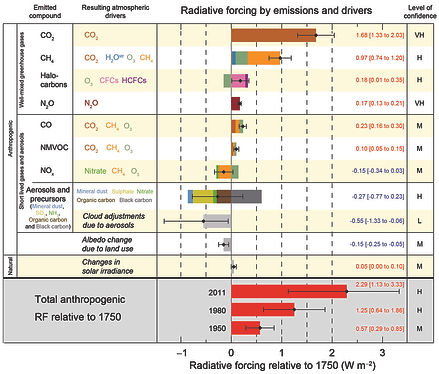
It is in high confidence that a substantial portion of the warming effect caused by the well-mixed greenhouse gases (WMGHGs) is offset by aerosols and cloud adjustments due to aerosols. Thus, great uncertainties in estimate of the total aerosol radiative forcing (RF) have caused great uncertainties in assessing the anthropogenic RF, and consequently, the future climate change.

The estimate on aerosol RF has been significantly improved since the last IPCC assessment (AR4). The cartoon above shows the major differences between the two most recent assessments. In AR4 (grey terms at the bottom), aerosol RF is assessed with three components - the direct and semi-direct aerosol effect, the cloud albedo and lifetime effect, and the impact of black carbon (BC) on snow and ice albedo. The AR4 designation is not a robust estimate on aerosol RF because it involves tropospheric changes in variables other than the forcing agent. Therefore, in AR5 (blue terms at the bottom), the concept of rapid ajustments is introduced: forcing agents can change the energy flow internal to the climate sytem; these changes can then affect the cloud cover or other components of the system. Rapid adjustments or responses indirectly alter the global energy budget. The net forcing of aerosols taking these rapid adjustments into account is defined as aerosol effective radiative forcing (ERFari and ERFaci). Although representing an improvement, the ERF definitions are far from perfect, because it turns out to be very difficult to distinguish the aerosol-radiation interaction (ari) from the aerosol-cloud interaction (aci) and vice versa. For this reason, in AR5, an expert judgement is executed for estimating ERFari and ERF aci.
In climate models, various complex forcing pathways and feedbacks associated with clouds and aerosols need to be represented. The following scheme (figure 7.1) provides a comprehensive overview.

Figure 7.1 | Overview of forcing and feedback pathways involving greenhouse gases, aerosols and clouds. Forcing agents are in the green and dark blue boxes, with forcing mechanisms indicated by the straight green and dark blue arrows. The forcing is modified by rapid adjustments whose pathways are independent of changes in the globally aver- aged surface temperature and are denoted by brown dashed arrows. Feedback loops, which are ultimately rooted in changes ensuing from changes in the surface temperature, are represented by curving arrows (blue denotes cloud feedbacks; green denotes aerosol feedbacks; and orange denotes other feedback loops such as those involving the lapse rate, water vapour and surface albedo). The final temperature response depends on the effective radiative forcing (ERF) that is felt by the system, that is, after accounting for rapid adjustments, and the feedbacks.
Major assessments on Clouds, Aerosols, Cloud-Aerosol Interactions, Radiative Forcings attributed to Anthropogenic Aerosols, Impact of Warming Climate on Precipitation, and Solar Radiation Management in Chapter 7, IPCC AR5 WGRI are reviewed by this website.